I saw the phrase “twice removed from reality” the same place that I get all my news and culture updates – on a meme.
For poetry in particular, or art in general, Plato argues that art is twice removed from reality, because it’s a copy of an idea
Art imitates idea and so it is imitation of reality. He gives an example of a carpenter and a chair. The idea of ‘chair’ first came in the mind of carpenter. He gave physical shape to his idea out of wood and created a chair. The painter imitated the chair of the carpenter in his picture of chair. Thus, painter’s chair is twice removed from reality. Hence, he believed that art is twice removed from reality.
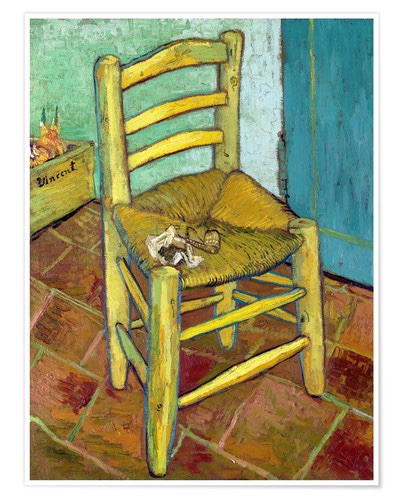
So basically, philosophy is better than art, because art is a copy of a copy of an idea, and it’s less than real. Aristotle comes in and counters in defence of art:
….Art also gives something more which is absent in the actual. The artist does not simply reflect the real in the manner of a mirror. Art cannot be slavish imitation of reality. Literature is not the exact reproduction of life in all its totality. It is the representation of selected events and characters necessary in a coherent action for the realization of the artist’s purpose. He even exalts, idealizes and imaginatively recreates a world which has its own meaning and beauty. These elements, present in art, are absent in the raw and rough real. While a poet creates something less than reality he at the same times creates something more as well. He puts an idea of the reality which he perceives in an object. This ‘more’, this intuition and perception, is the aim of the artist.
Read here
The argument goes back and forth for a while; But art doesn’t teach morality, nor inspire virtue…but who said it was supposed to teach us? Is it not just to inspire aesthetic delight? And if art is not trying to teach, is it fair to judge it for that?
Some of this is relevant to me, I’ve been thinking about the Transporter bridge (Middlesbroughs greatest bridge)
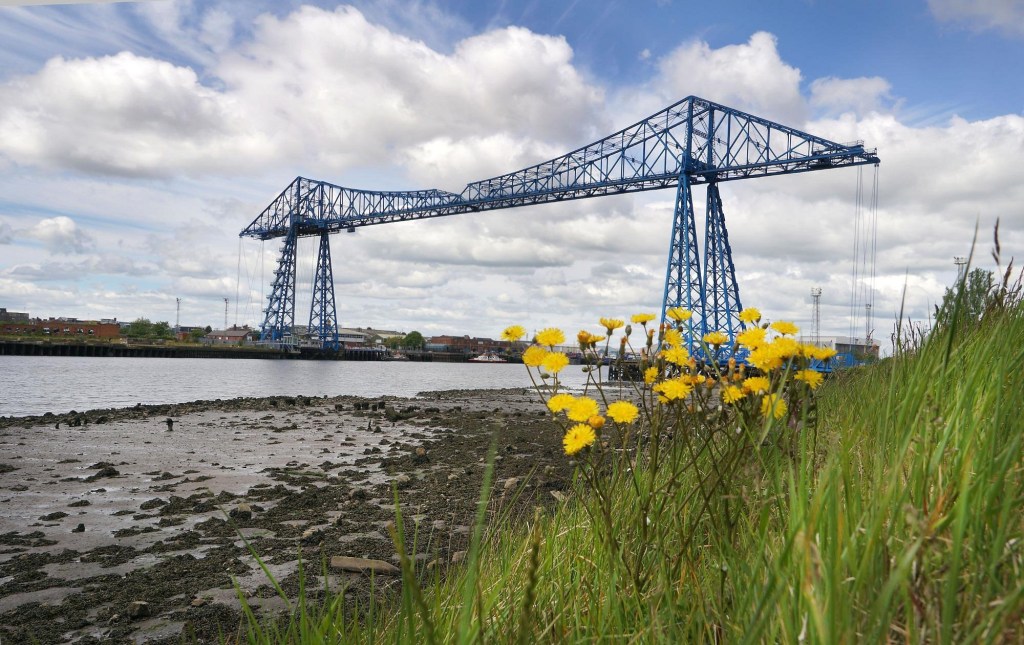
If you’re an artist working in teesside, and you want to sell work, you can do nothing better than depicting the transporter bridge – probably the most artistically replicated structure in teesside.
I’ve seen photography prints of this bridge, I’ve seen it on a tea towel, watercolours, oils, it’s likeness crafted in felt and sold on art stalls.
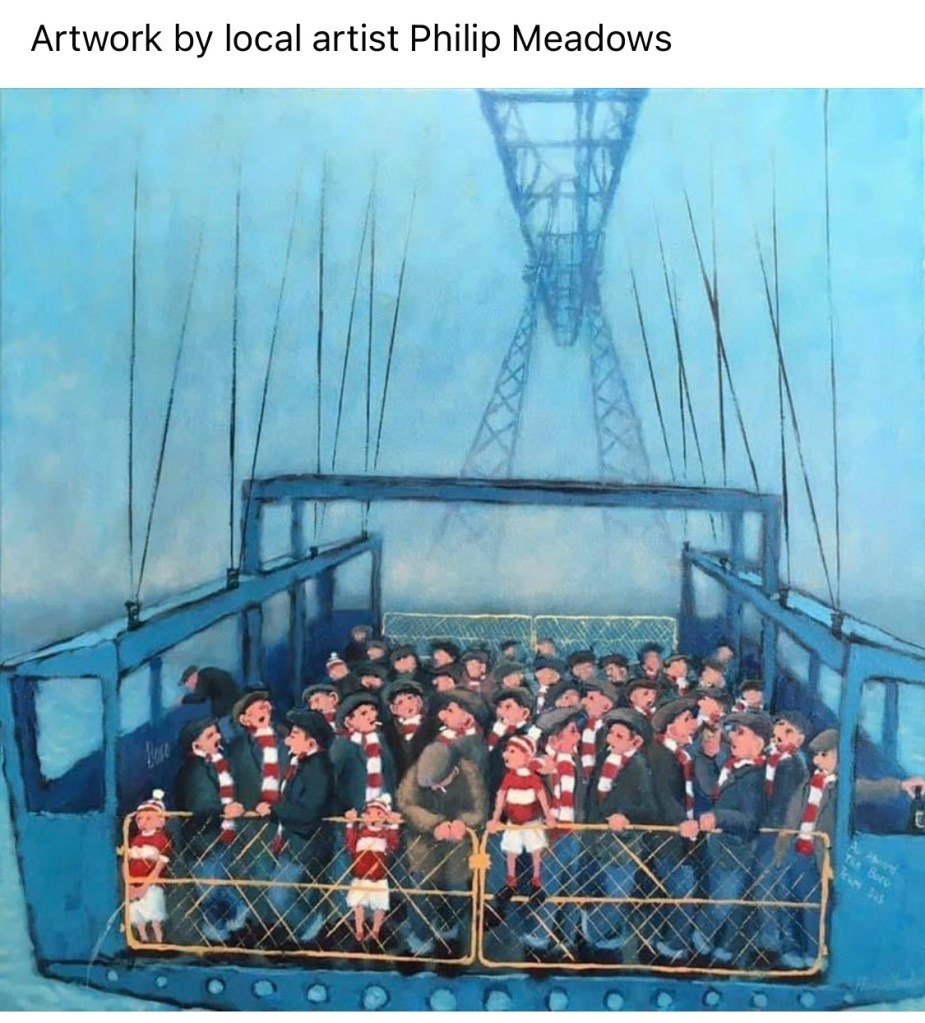
But of course there’s pushback – some artists think it’s tacky to paint, write about or otherwise depict the transporter bridge, it’s been done to death, it’s a joke now. I don’t know about this, it’s hard not to include in our art, the old industry that looms over us from all directions
What even is the Transporter Bridge? A bridge to take cars across the Tees – but it’s closed during the pandemic, and speculation is that it will never open again. So it’s not a bridge then, what is it? A monument to Teessides industrial past, is it technically a sculpture? Oh no, the Transporter bridge has become art.
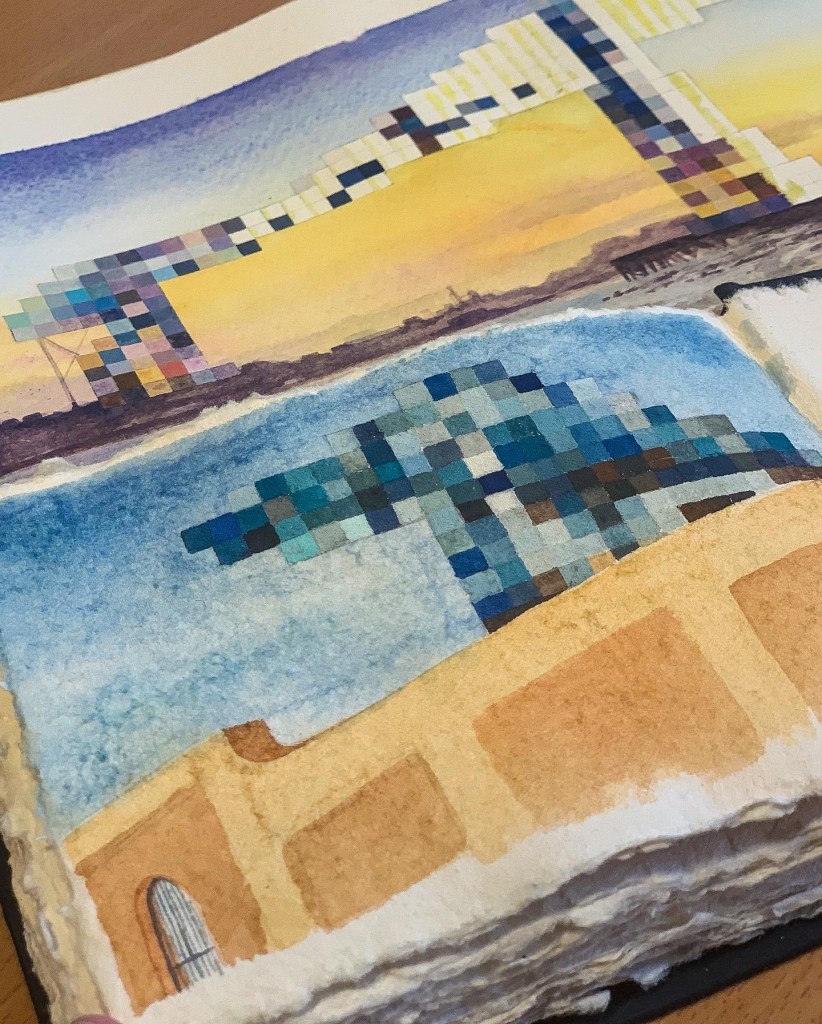
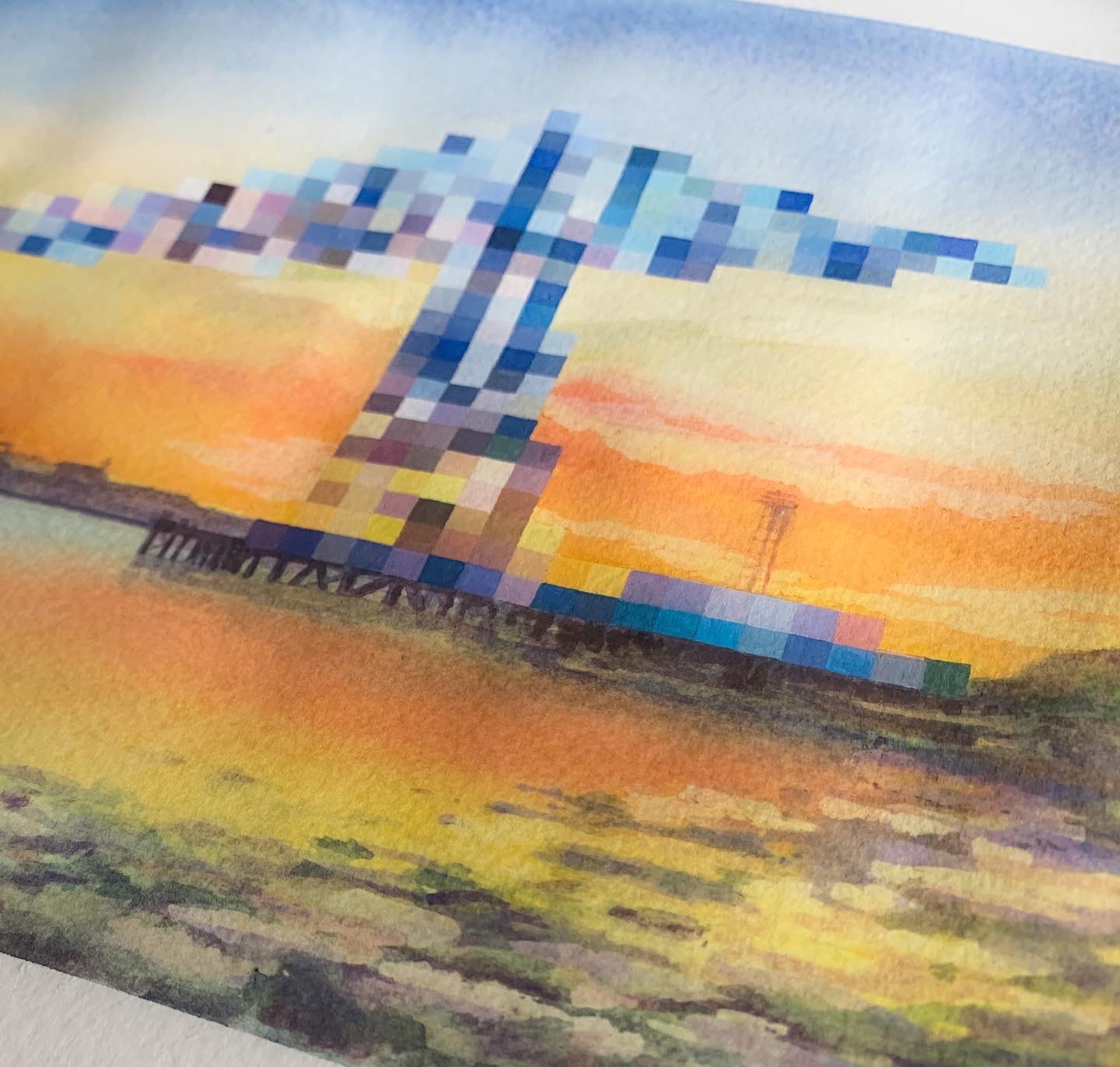
I did a sketch for the Home:Revisited exhibition – of the Transporter Bridge being ‘pixelated’ out of the horizon, so for the Working class: Revisited exhibition I ran with this idea
Using traditional gouache wash techniques, I created a landscape in the normal way you paint landscapes.
I’ve seen landscapes like this in small tourist galleries, where you can buy a picture of the place you’re visiting. There’s definitely a skill to it, one I’m not confident I actually have, but I did my best
I masked out the Transporter Bridge from the landscape, then went back and painted it in, painstakingly pixelated. I believe this must be a type of pointillism or expressionism, it looks fantastic from a distance
Every single square is a slightly different colour, all hand mixed and slightly opaque, thicker than the wash background. The end result is quite beautiful, though not perfect. I want to try this style of contemporary landscape painting again – maybe pixelating out other teesside landmarks until I have the whole of Middlesbrough removed
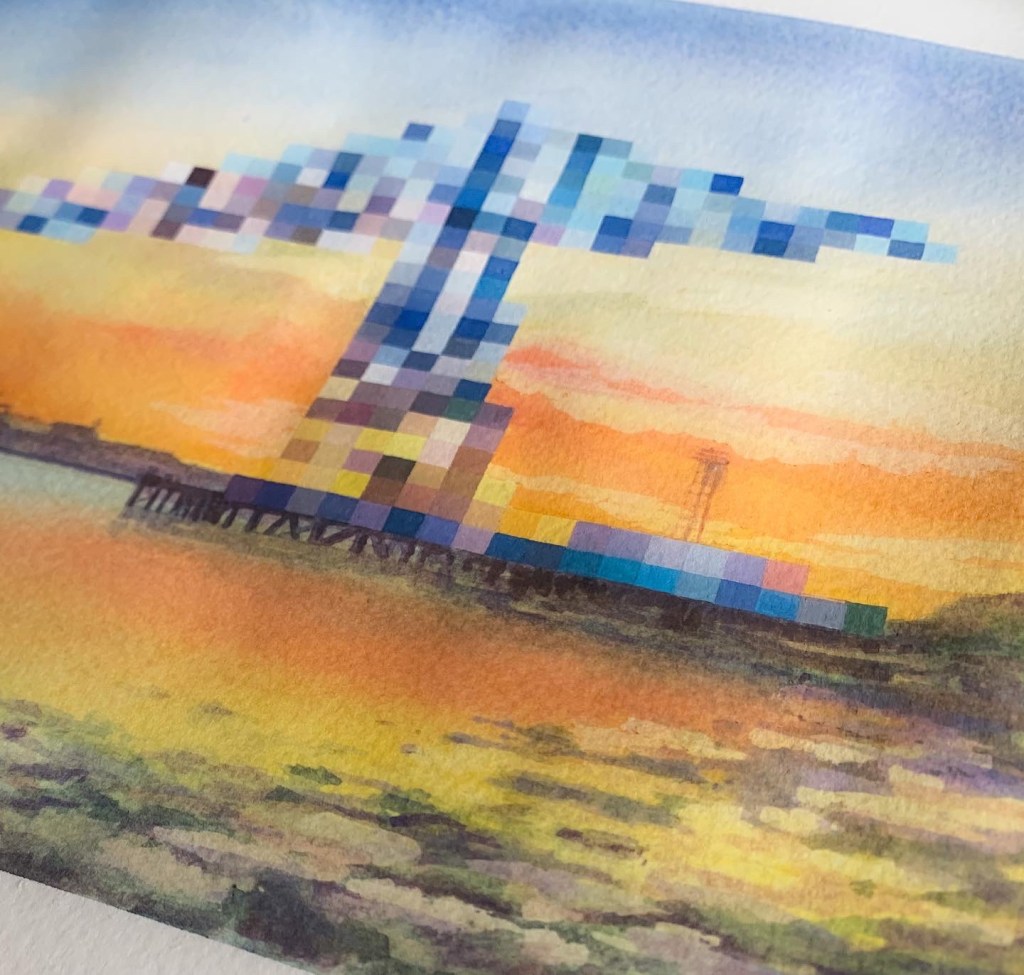
The working title for the painting was ‘Giant pixelated hentai Transporter cock’ but obviously I changed that for the exhibition. The work title/bio:
‘Twice Removed’ Gouache on Paper 2022
In the painting ‘Twice Removed’ (from reality) the artist attempts to capture Teesside’s iconic Transporter Bridge, but not really.
Will the bridge ever open again? Do we need it to? Can we call it a bridge anymore? Painted in traditional gouache on paper, in a contemporary style – Twice removed explores when art imitates a changing idea.
The exhibition runs through Jan/Feb:
 Aimee Charlotte